The double hip squeeze: how to do it in labour
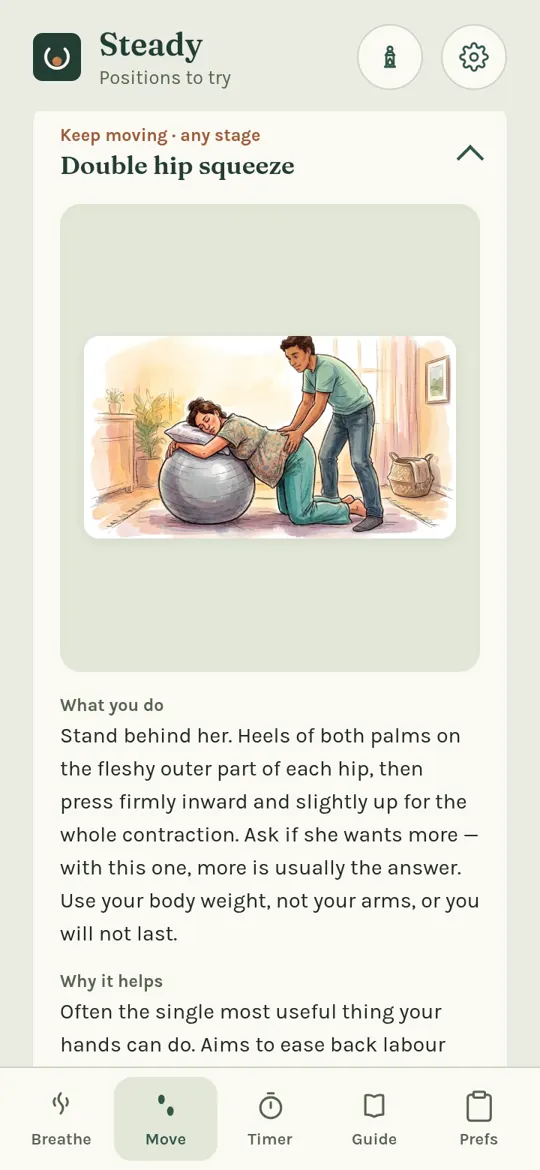
Quick answer: The double hip squeeze is where you put your hands on the fleshy part of each buttock and press inwards and slightly upwards during a contraction. It works best with her leaning forward and you using your body weight. Adjust to her feedback, stop if it hurts, and check with her midwife first if she has pelvic girdle pain.
Not medical advice. This article summarises widely published guidance from midwives, doulas and childbirth educators. Every pregnancy is different. Always follow the advice of your midwife, doctor or hospital, and call them (or 000 in an emergency) if you are worried.
The double hip squeeze is one of the best-known hands-on comfort techniques taught by doulas and childbirth educators. It's simple, needs no equipment, and many people in labour find it a big relief from back and hip pain. Here's how to do it well.
What is the double hip squeeze?
The support person places their hands on the fleshy part of the buttocks, over the hip joints, and presses inwards and slightly upwards during a contraction. It's commonly explained as easing pressure across the back of the pelvis and giving firm counter-pressure where many people feel labour pain, especially when the baby is lying with its back towards her spine.
How do you do the double hip squeeze, step by step?
- Get her into a forward-leaning position: on hands and knees, kneeling over a birth ball or the bed head, or standing and leaning on a bench or the bed.
- Stand or kneel behind her with your feet stable and knees soft. You'll be doing this for a while, so protect your own back.
- Find the spot. Place the heels or palms of your hands on the meaty part of each buttock, below the bony ridge at the top of the hip and roughly level with the hip joints. Fingers point up or out.
- Squeeze as the contraction builds. Press both hands towards each other, inwards towards the midline, and angle slightly up towards her waist. Lean your body weight in rather than using only your arms.
- Hold through the peak, then ease off as the contraction fades. Rest between contractions.
- Ask for feedback. "Higher? Lower? Harder?" The right spot and pressure vary a lot. A small shift can make a big difference.
Tips from doulas and educators
- It's usually firm pressure. Many people ask for more than you'd expect, but always go by what she says.
- Swap with a second support person or a midwife if your arms tire. Fatigue is normal.
- Combine it with slow breathing. Breathe out audibly with her as you squeeze.
- Try simple sacral counter-pressure too: steady pressure with the heel of one hand or a fist on the flat bone at the base of the spine.
- Talk about it before labour and practise a few times while she's comfortable.
When to be careful
- Stop if it causes pain rather than relief, or if she asks you to.
- Check with her midwife or doctor first if she has pelvic girdle pain or symphysis pubis dysfunction (SPD), a hip, back or pelvic condition, or has been advised against particular positions or pressure.
- Don't press on the spine itself, and avoid sudden or jerky pressure.
- If she has an epidural, she may not feel pressure accurately, so check with the midwife.
See where to put your hands
It's much easier when you can see it. Steady includes the double hip squeeze among 26 illustrated labour positions, 17 on land and 9 for the bath or birth pool. Each one shows where to put your hands, why it helps and when to be careful, and it all works offline in the birth suite.
Common questions
Where do you put your hands for a double hip squeeze?
On the fleshy part of each buttock, roughly level with the hip joints and below the bony ridge at the top of the hip. Then press inwards and slightly upwards during a contraction.
How hard should a hip squeeze be?
Often firmer than you'd expect, but always adjust to what she asks for, and stop if it hurts rather than helps.
Who should avoid the double hip squeeze?
Check with your midwife or doctor first if she has pelvic girdle pain or SPD, or a hip, back or pelvic condition.
Have it in your pocket on the day
Steady is a free Android app for birth partners, with a contraction timer, audio-guided breathing, 26 illustrated labour positions and a support guide. It works fully offline, with no account needed.
Get it on Google Play